Secure Wiring Solutions with Spade Crimp Connectors
Spade crimp connectors provide a simple and reliable way to join wires and components. They see heavy use in automotive, appliance, and general industrial applications. Often called quick disconnects, these connectors enable easy mating and separation of circuits with no tools required. That capability makes them well suited for switches, relays, motors, and other connections that require routine maintenance.
In both manufacturing and field service work, wire spade connectors are offered in insulated and non-insulated versions, with color coding to match multiple AWG ranges. A quality spade crimp connector should deliver strong conductivity, resist corrosion, and maintain a firm mechanical grip. In this guide, U.S. readers get help selecting suitable spade connectors and learn about wholesale choices for buying in bulk.
Main Takeaways
- Spade crimp connectors enable quick, tool-less connections for serviceable circuits.
- Electrical spade connector options cover insulated, non-insulated, and color-coded variants.
- You’ll find spade wire terminals frequently in automotive, appliance, and industrial gear.
- Choosing correctly means checking wire gauge, current capacity, and environmental exposure.
- Bulk buyers can source wholesale spade crimp connectors from distributors for consistent inventory.
Understanding Spade Crimp Connectors and Their Advantages
Recognized as quick-disconnect devices, spade crimp connectors feature a flat blade paired with a receptacle. Their design allows technicians to create secure connections without relying on soldering. They work well in both signal and power circuits. Offered as male and female, insulated and non-insulated types, they fit a broad range of AWG sizes, highlighting their versatility.
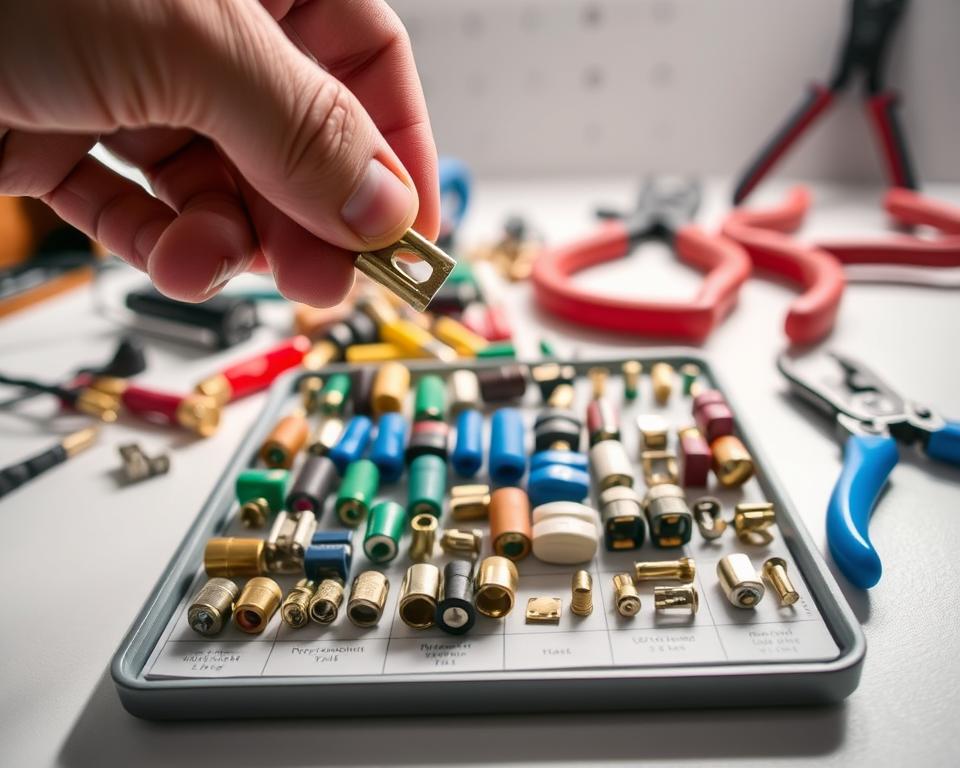
What spade crimp connectors are
They serve to efficiently link wires onto terminal posts or tabs. A male blade plugs into a female sleeve to provide solid contact. They commonly feature tin or nickel plating, which improves conductivity and helps prevent corrosion. These products usually list rated voltage and wire gauge, helping with proper selection.
Key Advantages: Reliability, Easy Installation, Corrosion Resistance, Cost-Effectiveness
Because they withstand vibration, spade terminal connectors are strong candidates for mobile and industrial environments. Crimping tools make the connection process faster and more consistent than soldering.
Options with insulation offer added strain relief and short circuit prevention. The corrosion-resistant coating maintains conductivity in demanding settings, reducing upkeep. Bulk purchasing of basic components can substantially cut costs for bigger projects.
Common industries and uses: automotive, marine, appliances, industrial equipment, renewable energy
Automotive systems often use spade terminal connectors for easily serviceable switches, relays, and wiring. Marine setups gain from their ability to resist corrosion, while home appliances and industrial panels leverage their quick assembly benefits.
In renewable energy systems, heavy-duty insulated spade connectors are often chosen for inverter and battery connections. Telecom and instrumentation systems also use them to keep wiring streamlined and easy to manage.
| Connector Feature | Main Benefit | Common Use |
|---|---|---|
| Male/Female variants | Fast mating and secure contact | Relays, switches, harnesses |
| Insulated spade terminal | Electrical protection and strain relief | Appliances, marine circuits, and exposed control panels |
| Tin/Nickel plated surfaces | Improved corrosion resistance | Outdoor solar, marine systems |
| Available AWG ranges | Matches signal to power wiring needs | Industrial, automotive, and renewable energy wiring |
| Female blade receptacles | Protected receptacle for flat blade terminals | Field service points and panel blocks |
Varieties of Spade and Quick Disconnect Terminals
Spade and quick disconnect terminals are designed for diverse applications in automotive, marine, appliance, and industrial sectors. The selection of a suitable model directly influences the reliability of connections, the capacity for electrical current, and maintenance simplicity. Below are the most common types and the unique advantages they provide.
Female vs. male terminals:
A female spade connector serves as a host for a flat blade. The male spade connector is the blade part that plugs into the female receptacle. Utilizing matching series like 110, 187, 205, and 250 guarantees a reliable connection and optimal electrical performance.
Insulated terminal options:
These insulated spade connectors deliver extra insulation and help limit wire strain. They are particularly popular for exposed connections or in areas with frequent vibration. Materials like PVC, nylon, and polycarbonate are selected according to the needed temperature rating and durability.
Multi-connection styles:
Using double spade connectors simplifies linking two wires at the same junction without solder. They have two receptacles on a single body, enabling parallel connections. A piggyback spade connector allows for the attachment of a second connector atop the first, making it ideal for circuit additions or tapping into existing signals.
Heavy-duty and compact designs:
For high-current applications, wide or large spade connector types are used to increase contact area and reduce resistance. Flag-style terminals solve space constraints by orienting the blade at a right angle for efficient panel mounting. Series like 187 and 250 frequently support flag and flanged versions, which remain compatible with standard panel hardware.
Selection tips and hints:
When selecting connectors, check both the series number and AWG size for compatibility with your wiring and hardware. Opt for double spade connectors or piggyback variants for complex circuits. For demanding applications, select wide or large spade connectors that are appropriately sized for the required blades and receptacles.
Spade Connector Materials, Color Coding, and Gauge Compatibility
When you select a spade connector, start by looking at the base material and plating. Common choices include tin-plated copper and brass for their conductivity and resistance to corrosion. For harsher environments, nickel or gold plating is preferred. PVC, nylon, and polycarbonate are common insulation materials that resist heat and abrasion.
It’s wise to match the insulation color with the wire gauge. This color coding makes wire selection faster and helps reduce wiring mistakes. Typically, red corresponds to 22–18 AWG, blue to 16–14 AWG, and yellow to 12–10 AWG wiring. So, a blue spade connector typically implies it suits 14 AWG applications.
Materials and plating commonly used for conductivity and corrosion resistance
Tin-plated copper offers strong conductivity at a reasonable cost. Brass, valued for its mechanical strength, can be plated to add more protection. For projects in marine or solar environments, sourcing nickel or specialized coats is crucial to prevent galvanic corrosion. Always review manufacturer datasheets for exact specifications.
Color coding and AWG implications
Color-coded insulation on spade terminals denotes AWG size ranges. Blue usually means the terminal is for 16–14 AWG wiring. When you pick a blue spade connector, it commonly matches medium gauges such as 14 AWG. To ensure a proper crimp, always verify the AWG rating on the product label.
Matching female spade connector sizes to wire and tabs
Female spade connectors come with different tab openings such as 3/16″ (0.187″) and 1/4″ (0.250″). These sizes correspond to the common tabs found on switches and relays. For precise matching, refer to charts that list female wire connector sizes. These assist in aligning terminal openings with the mating tab and wire gauge.
Compatibility typically ranges from AWG #10 through #24, covering series such as 110, 187, 205, and 250. Gauges heavier than #10 often call for ferrules or bigger lug terminals. Make sure the insulation material and crimp barrel size of insulated spade terminals match for a secure, code-compliant fit.
How to Select the Proper Spade Connector
Selecting the right connector depends on the specific job. Factor in current level, wire size, tab dimensions, and environmental conditions. It’s wise to review catalog specifications and manufacturer data to ensure voltage and temperature ratings fit your needs.
In high-power uses, select spade connectors featuring larger tabs like 1/4″ or 5/16″. These larger connectors manage heavy loads more effectively because of their broader contact area and lower resistance. For signal or low-voltage wiring, smaller 110 or 187 series connectors are usually preferred. They help maintain a tidy wire assembly.
Insulated vs Non-Insulated Spade Connectors: Environment and Safety
Opt for insulated spade connectors where short circuit risk, mechanical strain, or environmental hazards are concerns. These are ideal where there’s risk of vibration, contact, or moisture. In high-temperature situations or inside chassis wiring where insulation isn’t needed, non-insulated terminals are appropriate.
When to use female to female wire connector or double female wire connector for inline extensions
Female to female or double female connectors are handy for inline joins and fast fixes. They let you connect two male ends quickly without modifying the wires. This simplifies making adjustments to your wiring and facilitates maintenance in the field.
When you choose spade connectors, always consider wire gauge, current rating, and tab size. Check that plating and insulation can handle special conditions like saltwater or elevated temperatures. Always verify product data, customer reviews, and manufacturer reputations for reliability.
| Application Use Case | Recommended Connector Style | Key Specs | Notes |
|---|---|---|---|
| High-current supply | Heavy-duty spade connector | Tabs 1/4″–5/16″, AWG #10–#14, tin or silver plating | Select large tabs and sturdy crimp barrels to reduce resistance |
| Signal or low power cabling | Smaller series spade (110/187) | AWG #20–#24, with insulated variants available | Prefer insulated types for additional protection and strain relief |
| Inline extension or modular joins | Double female / female-to-female connector | Matches tab series; voltage rating per datasheet | Ideal for temporary repairs and modular harness setups |
| Marine or otherwise harsh conditions | Insulated spade with corrosion-resistant metal finish | UV-rated insulation, tin or nickel plate, correct AWG | Check salt spray test results and temperature ratings |
Best Practices for Crimping Tools and Techniques
For optimal crimps, it’s crucial to select the right tool. Pick a ratcheting crimper that aligns with the specific terminal series in your work. Calibrated crimping tools ensure consistently successful connections with insulated spade terminals. To maintain high-quality outcomes, perform regular calibration and pull tests.
Tools we recommend
- Ratcheting crimpers with interchangeable jaws for 110/187/250 series terminals.
- Ferrule crimpers for stranded wire conductors paired with sleeves or ferrules.
- Insulation-piercing tools for particular sealed connectors in situations without heat-shrink.
Proper strip length and placement
For a high-quality crimp, strip the wire precisely. Verify the conductor sits firmly in the barrel and that no bare wire sticks out. Place all conductor strands securely inside the barrel. This approach aligns insulation properly and removes the risk of loose strands.
Techniques for crimping and post-crimp inspection
- Place the terminal and wire straight in the crimper jaw to reduce misalignment.
- Operate the crimper until the ratchet unlocks, confirming full compression.
- Visually confirm the barrel is fully deformed and that no stray strands are present.
- Periodically perform pull tests on sample connections to verify their security.
Using sleeves and heat-shrink for protection
Using terminal sleeves boosts electrical insulation and strain relief in outdoor and vibrating installations. Use adhesive-lined heat-shrink tubing to create watertight seals in marine and renewable energy applications. A correctly applied heat-shrink layer enhances the crimp and lengthens its lifespan.
| Crimping Task | Tool of Choice | Main Benefit |
|---|---|---|
| Crimping insulated spade terminals | Ratcheting crimp tool with insulated-terminal dies | Uniform full compression for dependable mechanical and electrical performance |
| Crimp female spade terminals onto stranded conductors | Multi-stage or ferrule-style crimper | Reduces strand spread and boosts pull-out resistance |
| Connection protection and sealing | Heat gun plus adhesive-lined heat-shrink tubing | Moisture barrier and added strain relief for long-term durability |
| High-volume production checks | Calibrated crimping tools and pull-test jig | Ensures consistent quality while lowering field failure rates |
Typical Applications and Installation Examples
Spade terminal connectors are designed with a convenient quick-disconnect feature. Many industries highly appreciate this convenience. It enables quicker repairs and helps reduce downtime. Their form factor allows them to fit into tight spaces and still deliver reliable connections in regularly serviced systems.
Automotive wiring systems make frequent use of spade terminal connectors. They are essential for connections to switches, relays, sensors, lights, and motors. A 0.187″ female spade connector is often used to replace worn relay harness connectors in vehicles. Technicians at dealerships such as Ford or Toyota value this reliability, particularly when diagnosing starter or headlamp circuit issues.
Appliance and industrial control panels rely on spade connectors to keep connections repairable. They are crucial for rapid identification and isolation of circuits. They are installed on terminal blocks, circuit breakers, and toggle switches. Insulated fork terminals, utilized on control panel rails, are crucial in maintaining low touch voltage. This is particularly important for maintenance in commercial laundry and HVAC systems.
Renewable energy and marine environments demand connectors with strong corrosion resistance and good sealing. Select tin- or nickel-plated connectors with nylon or PVC insulation. Adhesive-lined heat-shrink sleeves are also essential in these conditions. These features safeguard connectors in solar array combiner boxes and boat navigation systems against environmental challenges.
Sample installations illustrate best practices tailored to each environment. When replacing a vehicle relay harness, pair 0.187″ female spade connectors with a quality precision crimper. For effective control panel setups, use insulated fork terminals on clearly labeled terminal blocks. This ensures easy servicing. For solar junction protection against moisture and corrosion, rely on heat-shrink insulated spade connectors plus adhesive-lined tubing.
Many suppliers list a broad selection of insulated products along with customer reviews. These reviews help you choose the most suitable components. Remember to verify temperature and voltage capabilities. Additionally, confirm that insulation and plating are appropriate for your environment. Attention to these details ensures dependable connections across automotive, appliance, industrial, renewable, and marine sectors.
Safety, Standards, and Buying from Wholesale Distributors
When buying spade terminal connectors for reliable electrical operations, consider ratings, materials, and traceability. Check datasheets for maximum voltage rating, operating temperature, and AWG compatibility. It is also crucial to match the crimp tool with the terminal series to maintain consistent crimps and results.
Seek product details that highlight maximum voltage and temperature tolerances. Confirm that AWG ranges match your needs, remembering that color coding usually matches wire sizes. Be sure to review series numbers such as 110, 187, 205, and 250 to ensure compatibility with your application.
Signs of a quality connector
Look for connectors featuring tin or nickel plated contacts and consider nylon insulation for better durability than PVC. Ask for datasheets, lot traceability, and proof of the manufacturer’s experience to judge quality. Review termination style, max wire gauge, and SKU details closely so you can make informed buying decisions.
Sourcing in bulk
For substantial orders, partner with a U.S. wholesale distributor that provides a variety of spade wire connectors. Installation Parts Supply offers extensive SKUs and gives insights into plating options, connector sizes, and lead times. Be sure to confirm minimum order quantities, SKU availability (such as 3/16″ female spade connectors and 1/4″ tabs), and whether terminal sleeves or heat-shrink accessories are included for volume purchases.
Procurement safety checklist
- Verify electrical spade connectors male and female series and ratings.
- Request datasheets and traceability for plated contacts and insulation materials.
- Match crimping tools to the spade terminal series to ensure proper crimps.
- Check MOQ, in-stock SKUs, and expected lead times with the distributor.
Final Thoughts
Spade Crimp Connectors are essential for fast, effective connections in various applications such as autos, boats, appliances, industries, and green energy initiatives. Select the right female spade or insulated spade connector by weighing tab size, wire gauge, material, and insulation type. Correct crimp tools and careful inspection are key to preventing failures and maximizing connector lifespan.
Well-defined color codes and SKUs make ordering and stocking much simpler. Bulk purchases of spade wire connectors are easier to manage. In environments with moisture or strong vibration, apply heat-shrink or terminal sleeves. This step improves durability and reduces stress on the connections.
If you’re handling a big project, buying wholesale from a reputable supplier guarantees quality, provides essential datasheets, and offers competitive pricing. When connections are properly selected, crimped, and protected, spade crimp connectors offer an efficient and resilient solution for electrical requirements.